“Why am I not a man that I could set out immediately and satisfy my curiosity and indulge my sight with wonders!- Since I have been in London there have been a great many little parties. I have attended only a very few of them… All the morning I paint whatever presents it self most pleasing to me. Sometimes I have beautiful objects to paint from and add historical characters to make them more interesting. Female and infantine beauty is the most perfect object to see. Sometime I indulge more melancholy subjects. History represents herself sometimes in the horrid, in the grand, the sublime, the sentimental, the pathetic…Thus the mornings are spent regretting they are not longer, to have more time to attempt again in search of better success, or thinking they have been too long and have afforded me many moments of uneasiness, anxiety and a testimony of my not being able to do anything.”
Maria Cosway to Thomas Jefferson 1787
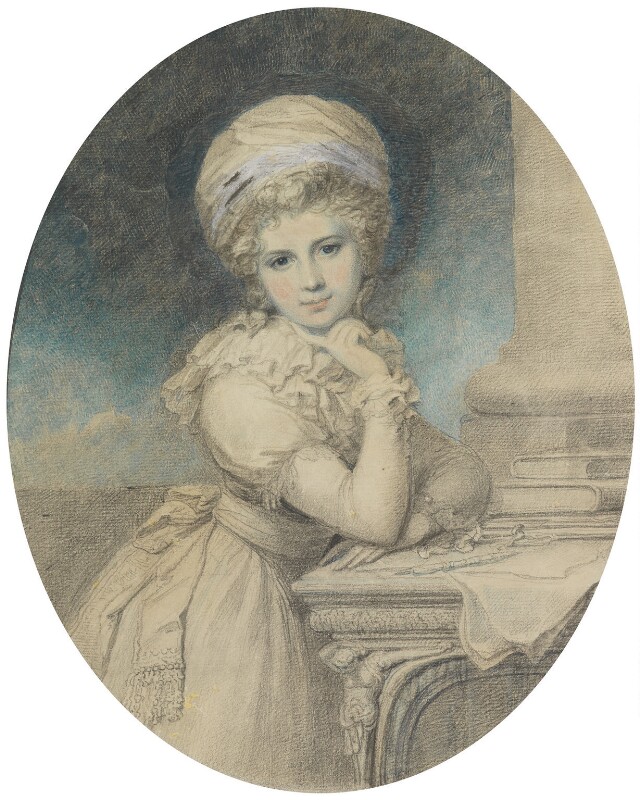
Maria Louisa Catherine Cecilia Cosway (née Hadfield) by Richard Cosway Pencil and watercolor, 1781-1785 NPG 7036 © National Portrait Gallery, London Creative Commons License Agreement
Maria Cosway (née Hadfield), also known as Maria Louisa Catherine Cecilia Hadfield or Maria Luisa Caterina Cecilia Hadfield lived from 1760*-1838, contributing to the arts such achievements as the emotional narrative “The Death of Miss Gardiner” in 1789 and later establishing schools for girls that included options for music and arts in Lyons and then later Lodi in the early 1800s. In 1781, Maria married artist Richard Cosway, whom despite an 18 year difference, shared haut monde status throughout the Regency period. But even early in her life, creative and personal connections influenced her talents and popularity.
“My inclination from a child had been to be a nun, I wished therefore to return to my Convent but my Mother was miserable about it & I was persuaded to accompany her – I had letters from Lady Rivers to all the first people of fashion: Sir J. Reynolds, Capriani, Bartolozzi, Angelica Kowffman. – I became acquainted with Mr. Cosway, his offer was accepted, my Mother’s wishes gratified and I married tho’ underage. – Kept very retired for a twelve month until I became acquainted with the society I should form, the effect of the exhibition, the taste and character of the Nation –“
– Maria Cosway from Head and Heart
Although she desired to be a nun, her mother insisted on her artistic education to secure her future in prosperous society. Creatively prolific at an early age, she was encouraged by the neoclassical painter Johann Zoffany, and introduced her to his society. Renown portrait artist Sir Joshua Reynolds influenced her style as she learned his techniques copying his works and eventually achieving his introduction as well. Cosway also studied Angelica Kauffmann’s work, a female founder aside Mary Moser for the Royal Academy. Upon meeting Kauffmann, she then persuaded her to join her creative circle, while painting miniature portraits for patrons of social prominence.
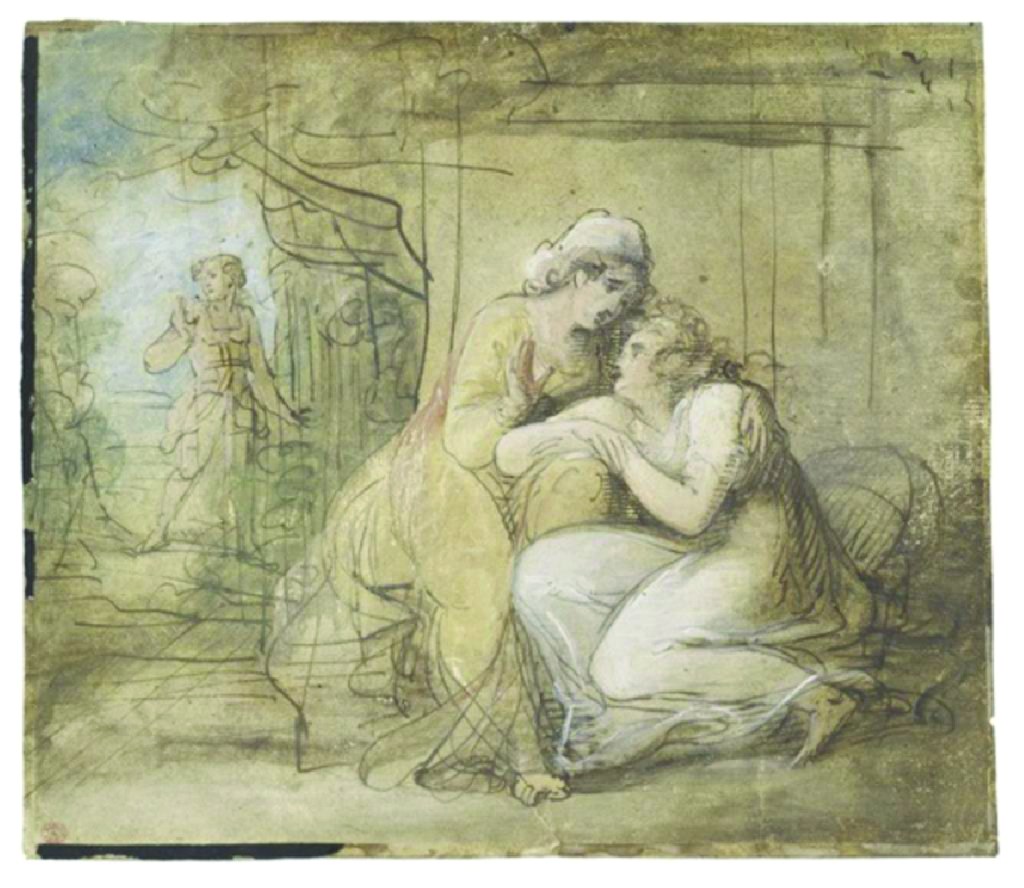
A preparatory sketch for The Death of Miss Gardiner
Medium: ink, gouache and watercolor on paper. No known copyright restriction. Art Net Auction
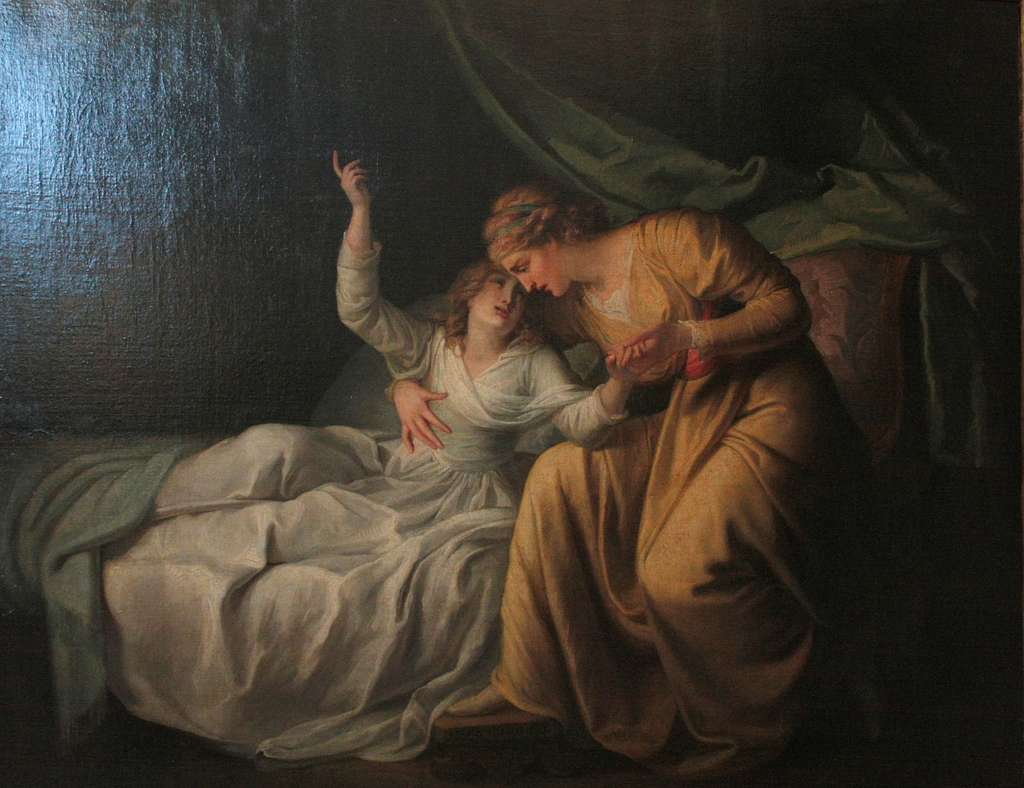
The Death of Miss Gardiner
Musée de la Révolution Française
1789. Wikimedia Commons
Both Reynolds and Kauffmann attributes are thought to have influenced “The Death of Miss Gardiner” with their sense of modeling and use of light. Cosway extends the practice of contrast between light and dark not only to establish mood, but to draw you in to the painful expression captured on the young subject. The piece was successfully exhibited at the Royal Academy solidifying her proficiency at modeling and depicting strong and realistic transferable emotion to the viewer. Also, an ink, gouache and watercolor sketch that may depict her preliminary studies of the piece survives, showing the time she would spend on studying models poses and expressions as any professional would do. The narratives she commonly paints are fueled by the skill of her depiction of humanity.

The Cosways were often subject to published parodies in the 18th c.
A Smuggling Machine or a Convenient Cos(au)way for a Man in Miniature
Museum number 1851,0901.60
Published by: Hanna Humphrey 1782
© The Trustees of the British Museum.
Shared under a Creative Commons Attribution-NonCommercial-ShareAlike 4.0 International (CC BY-NC-SA 4.0) licence.
At the urging of her Mother and Kauffman, Maria married Richard as he was determined the most socially eligible match. Although allowed to paint her friend’s portraits and compose music, he did not allow her to sell her paintings, perhaps to avoid more printed public criticism of his wife’s talents, and not to appear outdone by her (as parodied in A Smuggling Machine). Although she exhibited 42 pieces at the Royal Academy between 1781 and 1801, only but few paintings to her credit remain. Some of her pieces only survive as engravings by her own and other engraver’s hand. Some research simply exemplifies her as Thomas Jefferson’s romantic interest. But Maria leaves her own mark as an influencer.
In 1803 she founded the schools for girls in Lyons. When the post Revolutionary government suspended the operation, she traveled to Milan where the Duke of Lodi invited her to found a girls school, Collegio delle Dame Inglesi with the same model in 1812. Though the school ended its curriculum in 1978, what remains credit for generations of women perhaps inspired and influenced by Maria Cosway’s perseverance; those that saw her pieces displayed at the Academy, and surviving in engravings as prominent examples of traditional narrative art beyond the social strategies of miniature arts and limitations put on her. She earns the right to stand on her own, uncompared to others as an accomplished artist with the individual strength of connecting her viewers to her paintings, leaving a personal connection holding up to the passage of time.
*Some sources state the birth as 1759, the Maria Cosway Foundation states 1760.
A small possible example of what little remains of sketches of Maria’s work.
Young Woman with a Box c. 1790
Possibly Maria Louisa Catherine Cecilia Cosway (English, 1759-1838)
or possibly George Hayter (English, 1792-1871)
Medium: Pen and brown ink on cream wove paper
The Leonora Hall Gurley Memorial Collection
Reference Number: 1922.1160
CC0 Public Domain Designation

References
Bullock, Helen Duprey. My Head and My Heart, a Little History of Thomas Jefferson and Maria Cosway. G.P. Putnam’s Sons and the University of Virginia, New York, 1945.
Fondazione Maria Cosway. (The Foundation Maria Cosway). fondazionemariacosway. it. http://www.fondazionemariacosway.it/en/profile.html.
Kaminski, John P. Jefferson in Love: Love Letters between Thomas Jefferson & Maria Cosway. Madison House Publishers, Inc. Madison, WI, 1999.
Lloyd, Stephen. “The Maria Hadfield Cosway Exhibit.” Monticello, 25 Oct. 2022, http://www.monticello.org/research-education/for-scholars/international-center-for-jefferson-studies/talks-lectures-symposia-conferences/the-maria-hadfield-cosway-exhibit/.
“Maria Cosway.” Fondazione Maria Cosway, http://www.fondazionemariacosway.it/en/profile.html. Accessed 26 Jan. 2025.
Petersen, Karen, and J.J. Wilson. Women Artists: Recognition and Reappraisal from the Early Middle Ages to the Twentieth Century. Harper & Row, New York, 1976.
Spies-Gans, Paris. A Revolution on Canvas: The Rise of Women Artists in Britain and France, 1760-1830. Paul Mellon Centre for Studies in British Art, Yale University Press. New Haven and London. 2022.
Subscribe
Enter your email below to receive updates.
Salonnière Aquarelle
18th century watercolor history and techniques
 Salonnière Aquarelle