
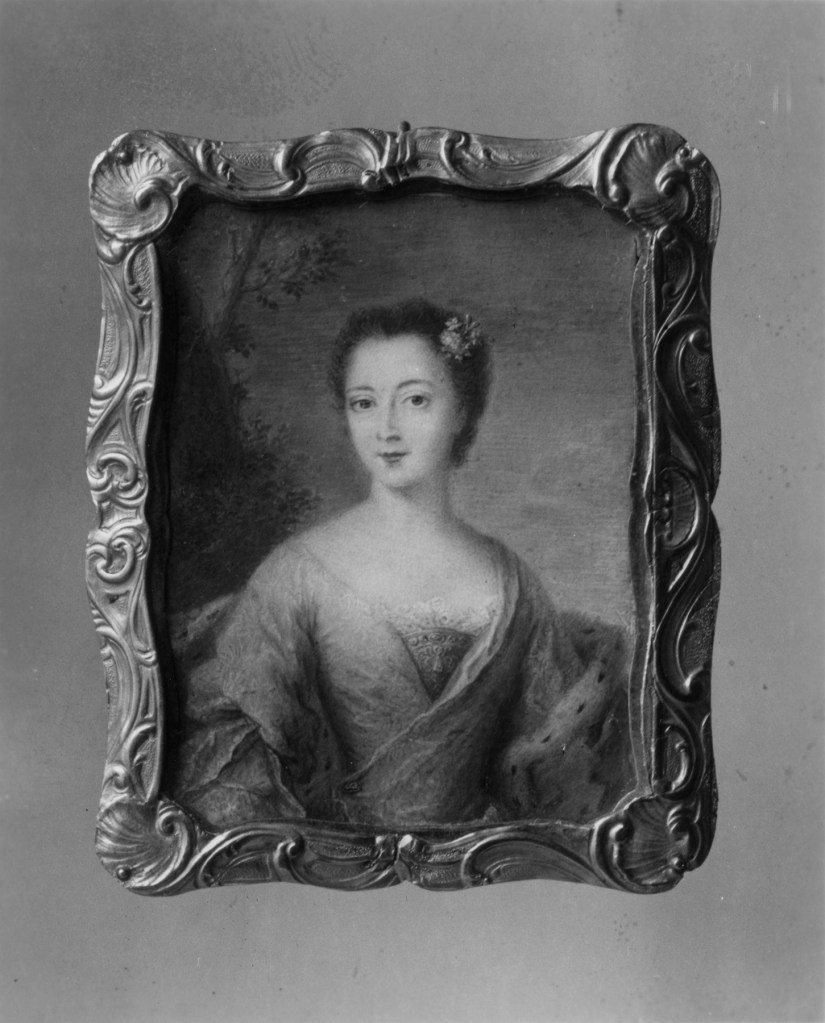
Miniature Watercolor Paper Portraits
Left: Portrait of a Woman – Unknown English Artist Watercolor on Paper, Backed with Green Fabric 18th Century H 2 13/16 x W 2 3/8 in • The Walters Art Museum
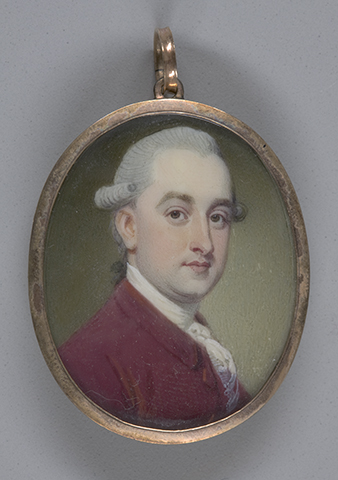
1940.542 • Yale University Art Gallery
Eighteenth century portraits bring to mind the popularity of ivory miniatures from it’s illuminating qualities of the pale fragment adorned with tiny layered strokes brushed on the surface, bringing the portrayal to life. Use of ivory in portrait miniatures were the typical base to apply water color medium during the approximate mid century to mid century lifespan across Europe and North Americas. But many of these likenesses started out as concepts on paper, surviving as less illuminating, but no less stunning renderings of the sitter.
A miniature’s life might originate on paper as reference for the final ivory piece or future duplicate. John Smart, well known for this practice in Britain and India, was prolific in graphite sketches with a wash usually of watercolor on paper. Known as ricordi, these preliminary exercises survive in museums for study. 1 Sketches remaining present questions of possible alteration in the final stage. Regardless, ricordi such as The Portrait of Lady Oglander retains a hue soft blue in her gown and eyes, ready to be transferred again to life with paints again.


Surviving paper portraits delicately rendered in graphite and watercolor feasibly may have meant to remain as paper likenesses. Paper versions offered a less expensive and laborious alternative to ivory, allowing to turn over more art and increase their amount of patrons. 1,5 On ivory, the sketchy and stippled layered strokes of the paint brushes was not only to manifest the likeness, but a means of allowing permanency of the paint to the smooth surface in addition to an adhesive. 3 For paper, an adhesive such as gum arabic was also used to aid the color to bond with the surface, but mistakes would be less costly to replace. 2
Unknown artists examples remain of moderately transparent watercolors over a sketch, in Europe as well as America, whether their intent a final piece or a reference copy, the effect of their control over the method is apparent.
Mary Way, an American portraitist, began adding whimsy novelty to watercolor figures on paper dressed in fabric in the late 18th c. Typically an English technique, her and her sister Betsy created dressed miniatures for the Connecticut elite. Likenesses of the face were painted on paper in profile, mounted on a painted or fabric background, with scraps of fabric applied as clothing. Her and her sister also practiced traditional water color and ivory and paper as well into the next century. 8

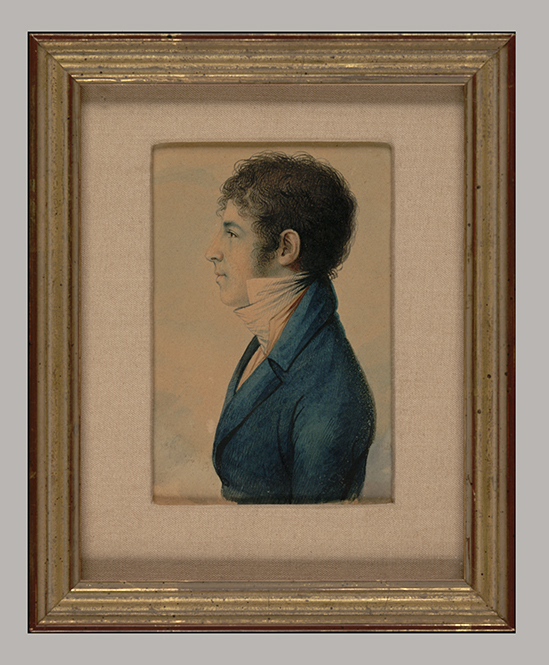
The practice of using water color on paper for miniature portraits grew towards the late century and into the next before losing its popularity to daguerreotypes. Washes make way for colors less diluted, demonstration intentions as a final piece. The profile view of the sitter we see in Way’s works as opposed to the usual three quarter view of traditional miniatures continues its popularity in paper likenesses. The idea of intimate, small miniatures gives way to a slightly larger size, intended to be shared with more than a single viewer, bringing a close to its reign in the portraiture business.
A Note on Ivory
Ivory was used for centuries by man as an art form or luxury item. Museums preserve these antiquities for their intrinsic value of culture and art. Today, laws restrict trade in ivory to protect animals for use as luxury items. In 1973, the Endangered Species Act and the CITES treaty for international trade help protect the animals hunted for such superfluous use. The ESA does have antique exemption for museums, but strict rules still apply. Trade of African elephant ivory received tighter restrictions about a decade ago to help ensure America is not contributing to the poaching of these majestic creatures. 9
References
- Aronson, Julie and Wieseman, Marjorie Perfect Likeness European and American Portrait Miniatures From the Cincinnati Art Museum Yale University Press, New Haven and London, 2006.
- Huisman, Philippe, French Watercolors of the 18th Century, The Viking Press NY 1969
- Johnson, Dale, American Portrait Miniatures in the Manney Collection The Metropolitan Museum of Art, NY, Harry N. Abrams, Inc, NY, 1990.
- Whele, Harry American Miniatures 1730-1850, Doubleday, Page & Company NY, 1927.
- https://www.clevelandart.org/art/1941.567
- https://collections.vam.ac.uk/item/O1067678/portrait-miniature-drawing-of-a-portrait-miniature-john-smart/
- https://www.themagazineantiques.com/article/dressed-for-success/
- https://www.incollect.com/articles/mary-way-and-betsy-way-champlain-evaluating-the-shared-artistry
- https://npg.si.edu/blog/ivory-national-portrait-gallery
Like what you see? Please donate.
 Salonnière Aquarelle