

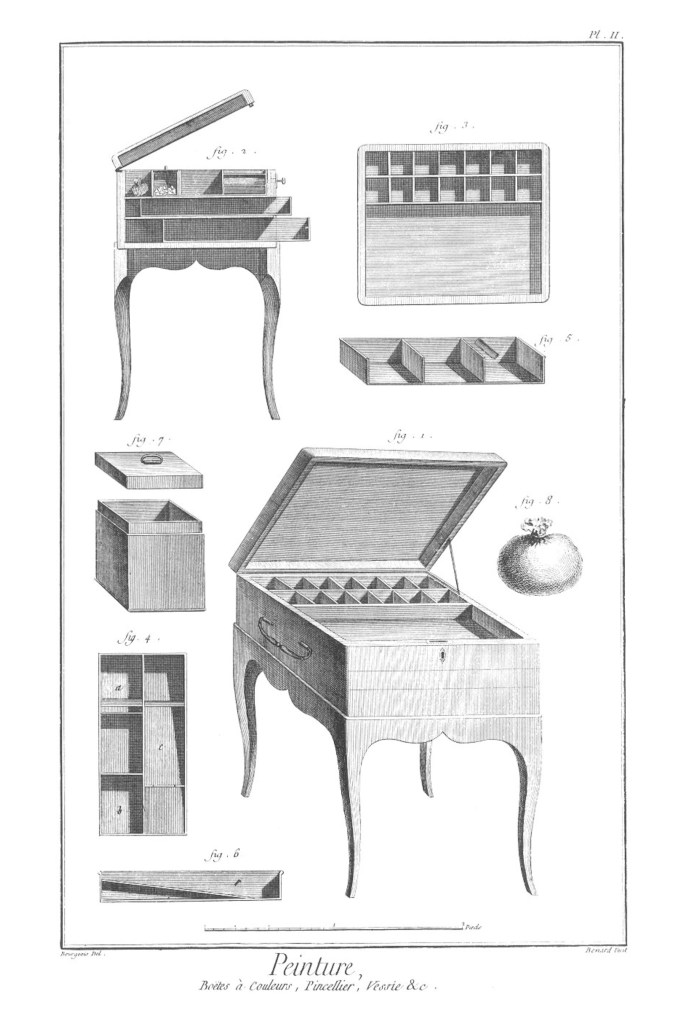
In the essential The Encyclopedia of Diderot and d’Alembert Paris, 1765, Diderot lists #8, a “vessie” alongside an artist’s table in Planche II, as an essential supply. The diagram is described as “Vessie pour mettre les couleurs brouillées.” This is translated into a “bladder to put the blurred [mixed] colors.” The bladder they refer to, is one of a pig, commonly used to hold paint colors before the invention of paint tubes common today. They fit in the palm of your hand and are sized to fit into the slots of the painter’s table. The recreation mimics Diderot’s example, tied at the top.
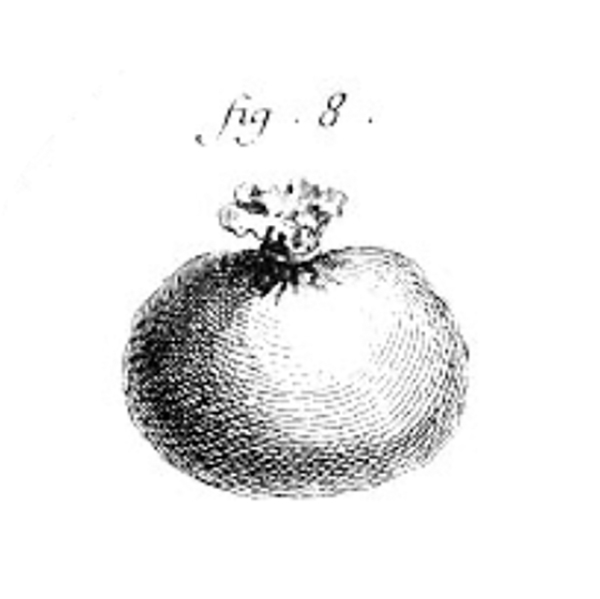
Using imitation pigs’ bladder, a display version of a Vessie can be created.
Supplies:
Scissors
Sheets of imitation pigs’ bladder
Bowl of water large enough to hold cut bladder sheet
Small cup or vessel
Twine
Prepared paint to fill vessie.
Cut a sheet about 6” to 7” square. Soak for five to ten minutes. Drape over a small cup or vessel. Fill with paint, leaving room to tie shut. Tie with twine, and allow to dry for overnight or a few days.
Reference
“Oil, miniature and encaustic painting.” The Encyclopedia of Diderot & d’Alembert Collaborative Translation Project. Ann Arbor: Michigan Publishing, University of Michigan Library, 2010. Web. [fill in today’s date in the form 18 Apr. 2009 and remove square brackets]. <http://hdl.handle.net/2027/spo.did2222.0001.589>. Trans. of “Peintures en huile, en miniature et encaustique,” Encyclopédie ou Dictionnaire raisonné des sciences, des arts et des métiers, vol. 8 (plates). Paris, 1765.
 Salonnière Aquarelle